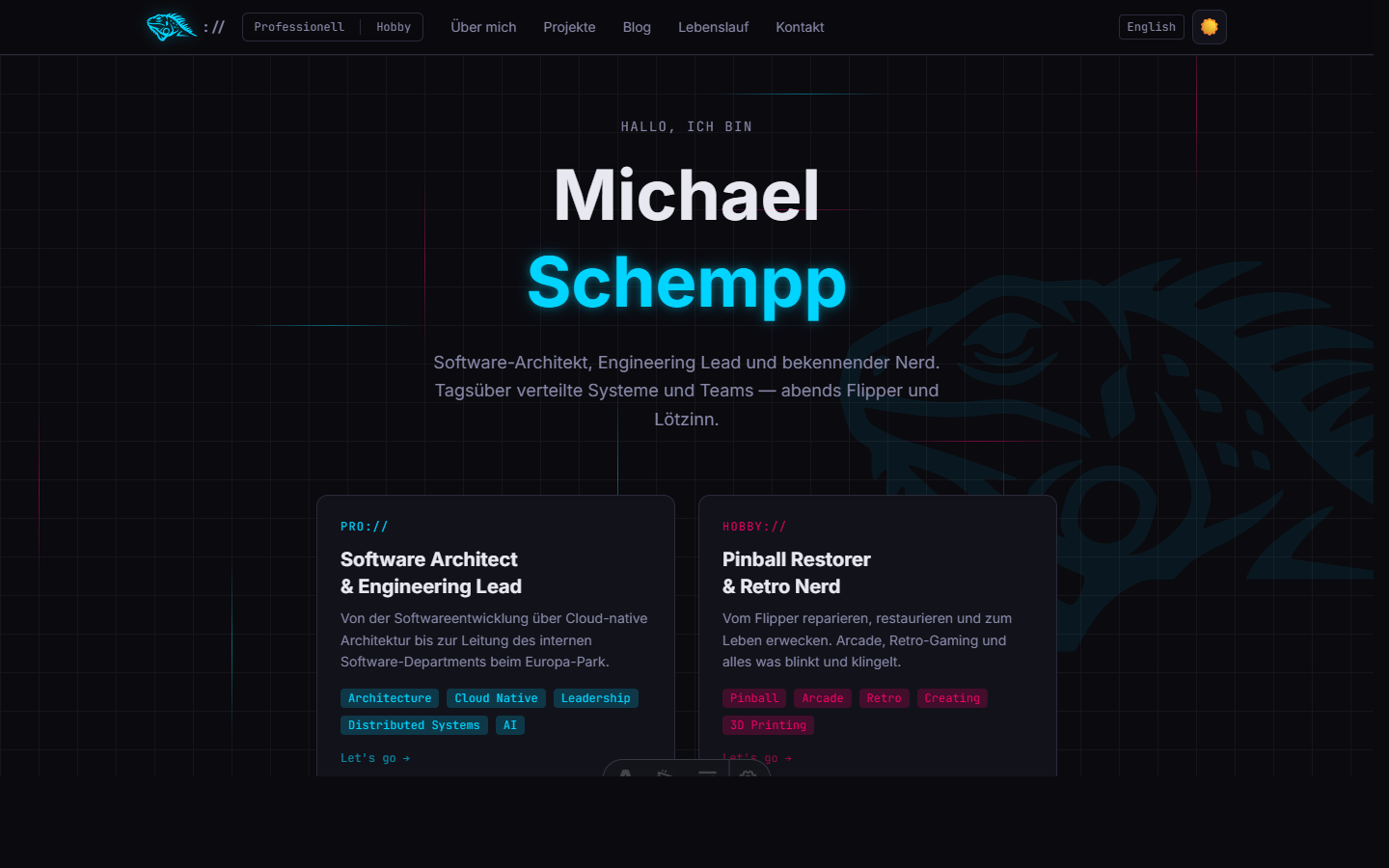
The Landing Page — two worlds, one entry point.
Motivation
I’ve wanted a personal website for a long time — partly as a digital CV, and partly as a space to showcase my hobbies and write about things that might help others. Pinball restoration, modding, 3D printing, etc. — these are just as much a part of me as software architecture and engineering leadership.
At the same time, I finally wanted to get to know Claude Code in practice, not just in theory. Building my own website seemed like the ideal framework: manageable enough to focus on the tool, but complex enough to require real design decisions.
One Website, Two Worlds
A key challenge was the underlying concept: two completely different areas under one domain.
- PRO:// — Software Architect, Engineering Lead, Cloud-native systems
- HOBBY:// — Pinball & Electronics, Retro, 3D printing, Gaming
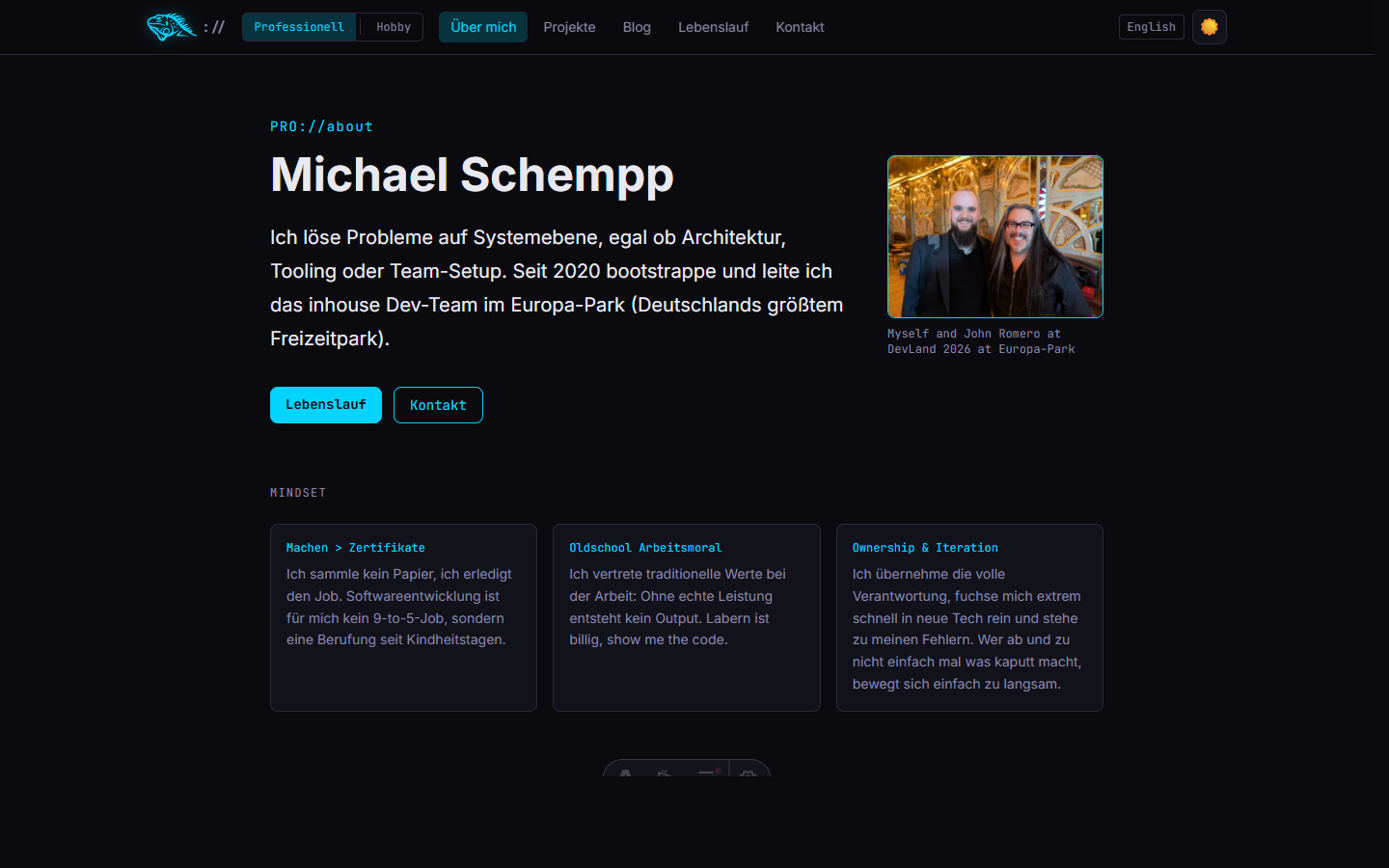
The PRO section — Cyan as the accent color, clean structure.
Claude Code understood this domain remarkably quickly. Based on my description of a “retro 80s arcade vibe, but professional and not too playful,” a design system with two color worlds emerged: Cyan for the professional side, Magenta for the hobby side. No hours-long design process, just an iterative conversation.
Claude Code as a Development Partner
What impressed me most was the speed at which the foundation was built — including i18n (German/English), Content Collections, routing, and the design system. Honestly, these are things that would have taken me significantly longer on my own.
However, I also quickly learned: Context is everything. Claude Code only delivers truly great results when you provide the right context. Inspired by Matt Pocock’s Skills approach, I started using reusable skills for Claude Code — small, focused prompts that act as tools during development.
One example is the grill-me skill, which I used for this very post:
---
name: grill-me
description: Interview the user relentlessly about a plan or design
  until reaching shared understanding, resolving each branch of the
  decision tree.
---

Interview me relentlessly about every aspect of this plan until we
reach a shared understanding. Walk down each branch of the design
tree, resolving dependencies between decisions one-by-one.
For each question, provide your recommended answer.

Ask the questions one at a time.

If a question can be answered by exploring the codebase,
explore the codebase instead.
Instead of just starting to write, Claude Code questioned me systematically — about motivation, tone, structure, images — ensuring the post reflected my actual experiences.
Effort and Result
In total, I invested about 16 hours, spread across several evenings and weekends. This includes iterations on content, multiple CV adjustments, and writing initial blog posts without AI assistance.
The result: a complete, bilingual website with its own design system, Content Collections, and CI/CD deployment.
Tech Stack
| Technology | Usage |
|---|---|
| Astro 6 | Static Site Generator, Routing, i18n |
| Tailwind CSS v4 | Styling via Vite plugin |
| Content Collections | Markdown-based content with type safety |
| Claude Code | Dev partner, code generation, skills |
Key Takeaways
Engineering is not dead. The difference between “Claude Code generates something” and “Claude Code delivers exactly what I want” lies in good context and the ability to critically evaluate and steer the results.
At the same time, even with a project as straightforward as a personal website, you can create real “wow” moments when AI support is used not as a shortcut, but as a tool within the workflow.
The next steps with Claude Code will involve more complex applications — to see what true agentic engineering looks like with non-trivial scope. There is still much for me to learn.
translated with Gemini